
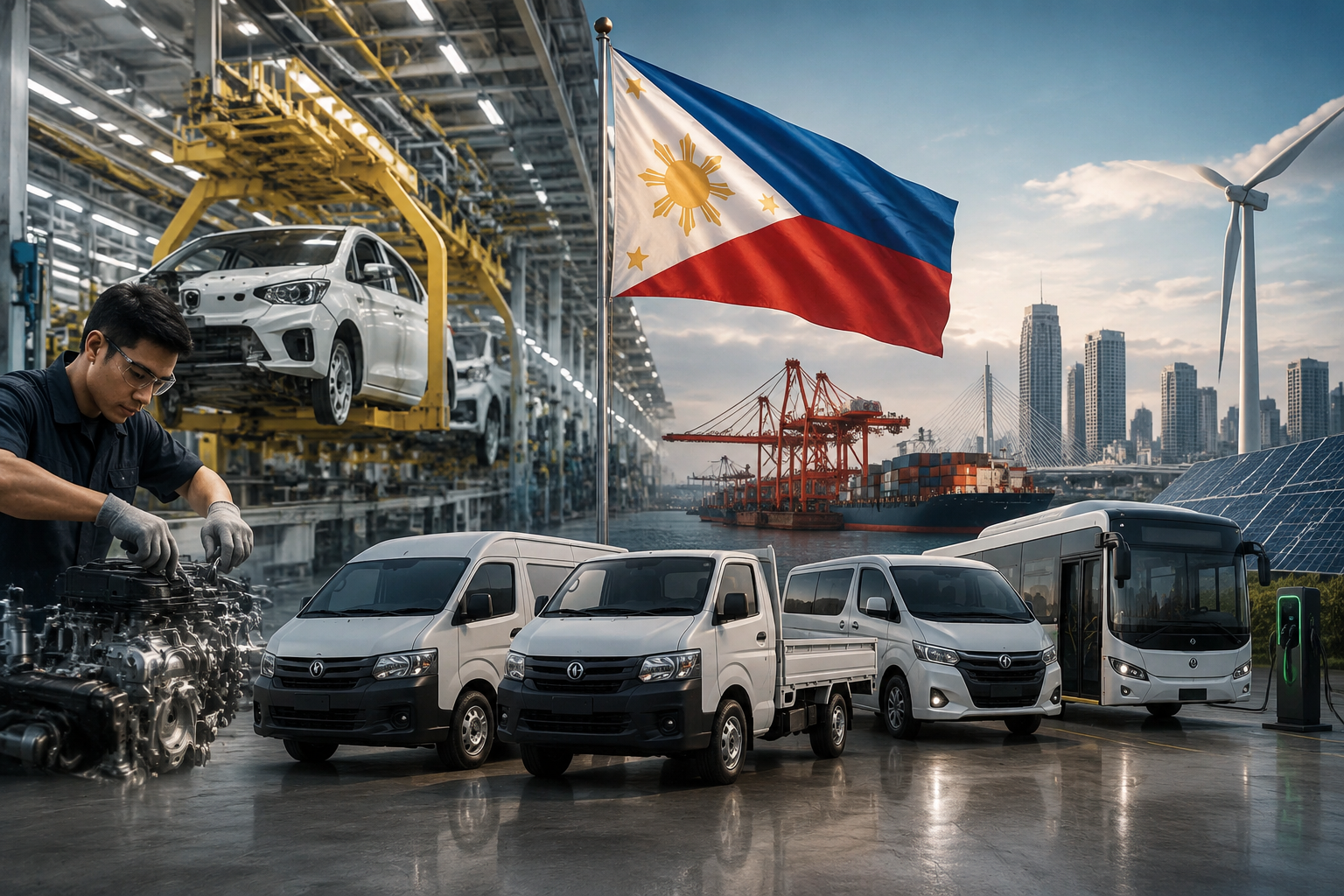
The Philippines may find its strongest automotive manufacturing opportunity not in conventional sedans, but in commercial vehicles designed for the country’s unique transport and business environment.
Delivery vans, public utility vehicles, minibuses, agricultural carriers, refrigerated trucks, and multipurpose utility platforms serve practical needs across thousands of islands and municipalities. These vehicles can also support local body builders and equipment suppliers because operators frequently require customized configurations.
This market differs from passenger-car production, where manufacturers must compete directly with large ASEAN factories producing hundreds of thousands of units. Commercial vehicles can be manufactured in smaller volumes while generating additional value through local modification and specialized equipment.
Transport policies and public utility vehicle programs are administered through agencies including the Philippine Department of Transportation. Official transport plans provide useful context for the long-running effort to improve roadworthiness, passenger safety, fleet efficiency, and emissions performance.
Public Utility Vehicle Modernization Creates Demand and Controversy
The modernization of jeepneys and other public utility vehicles represents one of the country’s most visible transport reforms. The objective is to replace aging vehicles with units offering improved safety, lower emissions, better accessibility, and more efficient fleet management.
Implementation has been controversial because many drivers and small operators cannot easily afford new vehicles. Consolidation requirements, financing terms, route planning, and unit prices have all created resistance.
This situation provides an important lesson for the automotive industry: a technologically advanced vehicle will not succeed when the financing model is disconnected from operators’ actual income.
Local production could reduce some costs, but manufacturing alone is not enough. Operators also need affordable loans, reliable maintenance, available spare parts, battery warranties, and predictable routes.
Electric Jeepneys Need a Complete Operating System
Electric public utility vehicles are often promoted as a solution to urban pollution and fuel-price volatility. Their success depends on more than battery capacity.
A viable electric jeepney program requires strategically located charging depots, sufficient electrical supply, trained technicians, replacement-part inventories, and schedules that allow charging without reducing passenger-service hours.
Fleet-based operations may be better suited to electrification than individually managed units. Vehicles returning to a central depot can use shared chargers and follow structured maintenance programs. This model also makes energy consumption and battery health easier to monitor.
Local Manufacturers Can Compete Through Customization
Philippine body builders understand local road conditions, passenger behavior, loading requirements, and operator preferences. This knowledge could become a competitive advantage when combined with modern chassis platforms and electric drivetrains.
Manufacturers could produce modular vehicles for school transport, tourism, mobile clinics, emergency response, urban delivery, and agricultural logistics. The locally assembled Toyota Tamaraw demonstrates the commercial potential of a platform that can support several body configurations.
The same approach could be applied to electric vehicles, provided that engineering standards and safety requirements are consistently enforced.
The Market Will Reward Reliability Rather Than Novelty
Commercial operators evaluate vehicles differently from private buyers. Exterior styling matters less than uptime, payload, fuel or electricity cost, repairability, and resale value.
An electric commercial vehicle that spends weeks waiting for a replacement component will quickly lose operator confidence. A locally supported model with modest technology but dependable servicing may perform better than a more advanced imported unit with limited after-sales support.
Philippine automotive manufacturing can therefore build a defensible position by focusing on durable vehicles, practical customization, localized service, and transparent ownership costs. Commercial mobility could become the segment where domestic production delivers the clearest economic and social value.