
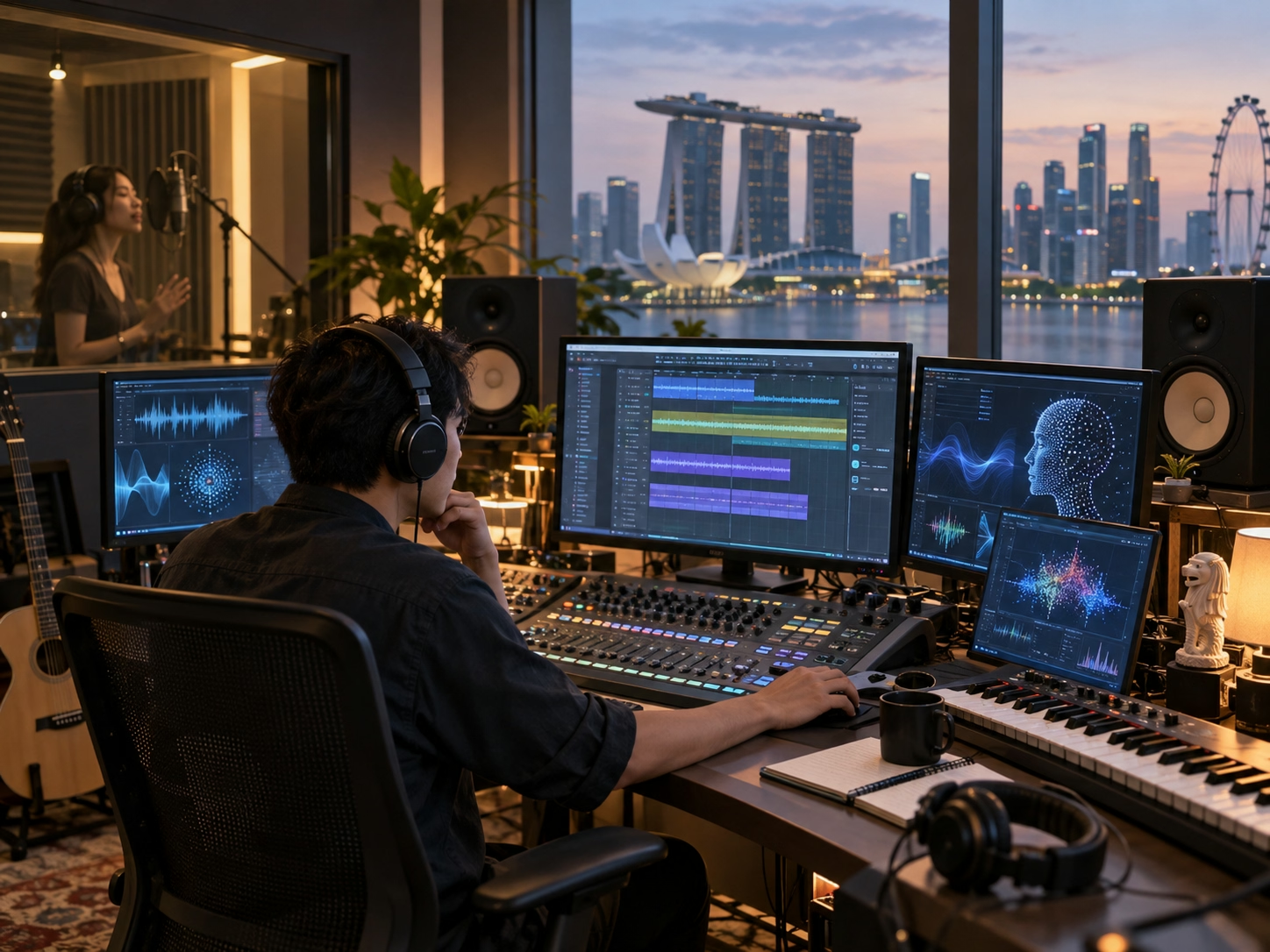
The Singapore government has committed unprecedented resources to ensuring its media and entertainment sectors remain globally competitive amid rapid technological disruption. The scale of investment—and the strategic logic underpinning it—reveals a policy framework that treats creative capability as essential national infrastructure.
The Digital Content and Capability Development Programme
In June 2026, the Infocomm Media Development Authority (IMDA) launched the S$48 million Digital Content and Capability Development (DCCD) programme, spanning four years and designed to help media professionals compete in an increasingly digital-led landscape.
The programme operates through two interconnected pillars. First, digital content development supports the creation and distribution of Singapore-centric stories across social platforms, digital channels, and mobile-first formats. Second, capability development fosters innovation in emerging formats, AI-generated content, and short-form episodic production across both live-action and animation.
The strategic rationale is grounded in audience behaviour. Approximately 87 per cent of Singapore residents aged 15 and above access top social media video platforms weekly, with short-form videos and AI-assisted workflows gaining substantial traction.
Accreditation, Access, and the CFP Mechanism
Participation in the DCCD programme requires companies to undergo an accreditation exercise assessing their content development capabilities and track record. The first exercise accredited 117 companies, with the inaugural Call for Proposals launching on 18 June 2026. This gated approach ensures that public funding flows toward organisations with demonstrated capacity to execute at professional standards.
National Arts Council: Broadening the Production Grant
Complementing IMDA’s digital focus, the National Arts Council (NAC) has restructured its Production Grant framework to create more opportunities for arts companies and individuals. As of April 2026, the Production Grant and Presentation & Participation grants have been consolidated, with the grant quantum cap raised to S$100,000 per applicant per financial year.
Applications can now be submitted across three General Grant cycles annually, rather than once a year—a change explicitly designed to accommodate productions and music recording projects with greater flexibility. Music recording projects are now supportable under the Presentation & Participation (General) grant, alongside exhibitions, performances, and festivals.
The National AI Impact Programme
IMDA is also embedding AI skills development into its broader workforce strategy through the National AI Impact Programme, which aims to train 100,000 non-tech professionals across industries to be “AI bilingual” over the next three years. Curated AI courses specifically for media professionals are available as a one-stop resource, covering applications such as generative AI for social media content creation on TikTok, Instagram Reels, and YouTube Shorts.
What This Means for Singapore’s Creative Ecosystem
The funding architecture reveals a coherent strategic vision: Singapore will not attempt to compete with larger markets on volume or scale. Instead, it will invest in capability—the skills, tools, and business models required for Singaporean creators to produce distinctive, high-quality content that resonates across digital platforms and international markets.
For media companies, the message is unambiguous. Public funding is available, but it is performance-gated. The accreditation requirement, the competitive Call for Proposals mechanism, and the emphasis on AI competence collectively signal that adaptation is not optional. The S$48 million programme is less a subsidy than an investment mandate: demonstrate capability, embrace technology, and deliver content that justifies the state’s confidence.